How Screen Time Isn’t the Break You Think It Is
Episode 11 of The Raising Kids With Purpose Podcast: What the latest research says about handing young kids handheld devices and allowing them to have “screen time”, and why the “break” you’re getting may be costing more than you realize. Download my free Screen Free Menu to give your kids other things to do!
Listen on your favorite podcast player:
Let me set a scene you might recognize.
You’re planning a long trip, a flight, a road trip, a holiday with the whole family, and almost instinctively, you think: we need something to keep the kids occupied. So you download some apps, maybe even buy a tablet. And for the duration of that car ride or flight? Bliss.
But what comes after? The meltdowns, the inability to settle, the big emotions that feel completely out of proportion to what’s happening. The child who, an hour before, was perfectly content on a device is now inconsolable.
We now have the brain science to understand why this happens!
And once you understand it, you can’t unsee it. My hope is that as you learn and know better, you’ll make choices that will positively impact your child’s brain development.
The Conversation About Screen Time for Young Kids
Technology is not the enemy. Or at least having this thought and belief isn’t helpful because we can’t escape it in today’s world unless we become Amish or move far from society!
Handing your child a screen so you can make a phone call, cook dinner, shop, go out to eat, or just have five minutes of quiet is not something you need to feel guilty about.
But here’s what most parents don’t know: there’s now significant research on what screen time, specifically handheld devices, is doing to young, developing brains. Not just “too much screen time is bad” in a vague, general way. Actual, measurable, neurological impact.
When I work with families in coaching, and we’re trying to understand why a toddler or preschooler is struggling with behavior, emotional regulation, sleep, attention, one of the first questions I ask is about technology use.
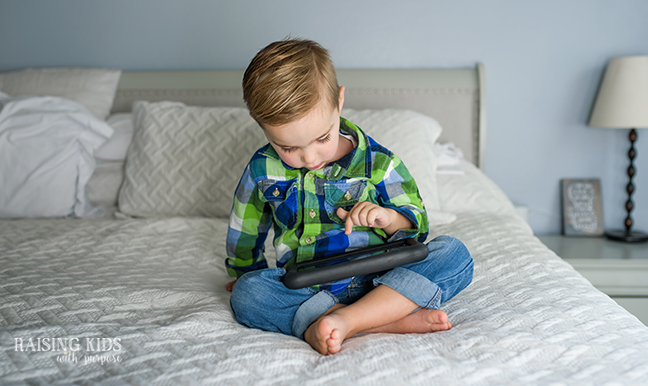
Almost every time, parents get a little sheepish. They’ll say, “Well, we do let them watch movies…” That’s usually fine. But what I hear more often is that a young child is spending significant time daily with an iPad in their hands. And in many of those families, it started as a way to manage behavior, and it quietly makes the behavior harder.
Read next: The Best Way to Keep Kids Entertained WITHOUT Screens
How Screen Impacts Your Child’s Brain Development
The most critical window is right now
The first five years of a child’s life represent the most intense period of brain development that will ever occur.
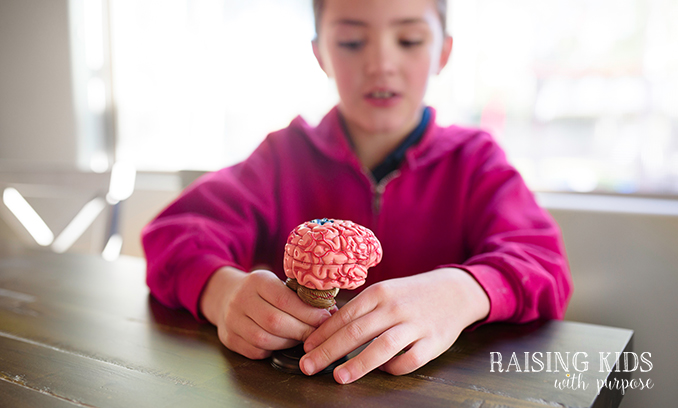
Neural pathways for language, attention, emotional regulation, and social connection are literally being wired during this window. Every experience shapes that architecture, and screens are an experience.
The research is detailed and, frankly, sobering:
- Increased early screen time has been linked to measurable reductions in brain cortex thickness: The part of the brain involved in thinking, reasoning, and cognitive development
- More screen time at preschool age is directly associated with worse attention problems showing up in later childhood
- Tablet use as early as age 3.5 was linked to increased anger and frustration by age 4.5: Children who were more frustrated used more tablets going forward. It’s a self-reinforcing cycle.
- Background TV: Even when a child isn’t actively watching a television, having it on in the background can reduce the number of words, conversations, and new vocabulary a toddler is exposed to, which directly impacts language development
This is a growing, consistent body of evidence. You can learn more from Cris Rowan’s Fact Sheet.
Devices can not calm kids down
This is the part that stops parents in their tracks. When we hand a dysregulated child a device to help them settle, and it works, we feel like we’ve solved the problem. But what’s actually happening is that the device is doing the emotional regulation for them.
Self-regulation is a skill.
It develops through practice: through experiencing discomfort, learning to tolerate it, and eventually moving through it.
When we consistently outsource that process to a screen, the brain never builds those pathways. Research confirms that frequently using mobile devices to calm young children is associated with increased emotional reactivity over time, especially in boys and children who are already highly reactive.
The device isn’t teaching them to regulate. It’s teaching them that they don’t have to.
Fast Dopamine vs. Slow Dopamine
Here’s the most accessible way I know to explain what screens do to a young brain.
Think of dopamine as the brain’s reward signal — the feeling of satisfaction and pleasure. Screens, especially interactive ones like iPads, deliver dopamine instantly and intensely. It’s like a fireworks show. Building a block tower, drawing a picture, digging in the backyard — those things also deliver dopamine, but it’s a slow burn. Earned through effort, imagination, and persistence.
A young brain that gets accustomed to fireworks will start finding candles boring.
That boredom isn’t laziness or defiance. It’s a brain that has been calibrated to expect a level of stimulation that real life can’t match. And it shows up as the inability to self-entertain, the need for constant input, and the explosive reaction when the device is taken away.
The good news: it’s reversible. But it requires intention.
Read next: Teaching These 7 Ideas Helps Meet the Emotional Needs of a Child
What the Guidelines Say — And Where I Part Ways
The American Academy of Pediatrics recommends zero screens for children under two, no more than one hour per day for ages three to five, and two hours maximum for ages six to twelve. Those are the official numbers.
Here’s my honest position: I think those guidelines don’t go far enough — and they’re focused on the wrong variable.
The question isn’t just how long. It’s what kind of device and at what distance.
Handheld Devices Are a Completely Different Category
A child watching a movie on a television across the room is a fundamentally different neurological experience than the same child holding an iPad six inches from their face. The proximity matters. The interactivity matters. The blue light at close range matters.
Research shows that blue light from up-close screens causes documented damage to developing retinal cells, disrupts melatonin production, and significantly impacts sleep quality — even in very young children. Small portable screens used over extended periods are now being described in the research literature as “real neurodevelopmental disruptors.”
My personal stance, informed by years of coaching families and studying this research: I don’t believe young children should have a handheld device in their hands at all — and by “young,” I mean well into the teenage years. Not a phone. Not a tablet. Not an iPad as a default tool for managing their time or behavior.
A television at a distance, with content you’ve intentionally chosen, watched for a limited time? That’s a conversation. A three-year-old with an iPad as a daily companion? That’s something different entirely.
I’ve never once heard a parent say, “I really wish I’d given my kid technology sooner.” Not once.
The Crazy Cycle Nobody Talks About
Here’s the painful irony that comes up over and over in my work with families.
A parent reaches for the iPad because their child is difficult to manage — demanding, dysregulated, hard to settle.
The iPad provides immediate relief.
But over time, the consistent device use is quietly contributing to the very behaviors that made the parent need the break in the first place: the emotional volatility, the attention difficulties, the poor sleep, and the low frustration tolerance.
So the behavior gets harder.
The parent needs more breaks. The iPad gets used more. The behavior gets harder still.
Using the iPad for Different Reasons
I worked with two families recently who both came to me struggling with their children’s behavior, but for different reasons.
Screen Time as a Motivational Tool
The first mom was using screens as a motivational tool:
Get through dinner, earn iPad time.
Finish your homework, earn iPad time.
It felt logical.
But what she noticed over time was that her children were becoming increasingly dysregulated and difficult to manage outside of those reward windows. The anticipation of the screen was creating anxiety, and the removal of it was creating chaos.
We built a customized plan together that shifted the motivation structure entirely, removed the device dependency, and replaced it with connection-based rewards. The change in her children’s behavior within a few weeks was significant.
If this is you, join me for a Parent Support Discovery Call, and we can talk about how you can wean your kid off of the iPad and stop using it as a motivational tool.
Screen time as a break
The second family was using screens purely for a break.
Both parents working from home, two young kids, a household running at capacity.
The iPad was a survival mechanism.
When we looked at the patterns, the worst behavioral stretches of each day lined up almost exactly with post-screen time. We created a personalized rhythm for their family that gave the parents actual breathing room without relying on devices, and her child’s emotional regulation improved noticeably within the first two weeks.
Do you see the pattern?
“But It’s How They Connect With Their Friends.”
This one comes up in almost every coaching conversation I have about screen time, so I want to address it directly.
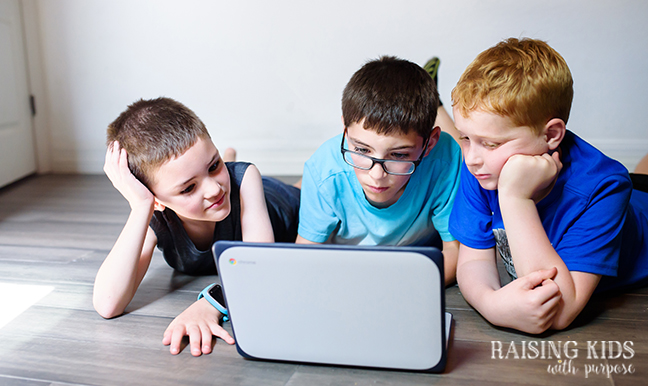
Parents will often hold onto device use — especially gaming — because their child is doing it with a friend. It feels social. It feels like a connection. And I understand why that’s a hard thing to take away.
But here’s what the research and my own observations tell me: when children play games together — whether side by side or online — the interaction becomes about the game, not about each other.
Here is a list of social skills they are not getting:
- They aren’t reading each other’s facial expressions.
- They aren’t navigating disagreement or disappointment.
- They aren’t practicing the give-and-take of real conversation.
The social skills that actually build the brain for relationship — empathy, conflict resolution, emotional attunement — those require presence. They require mess and boredom and the awkward silences that kids have to figure out how to fill.
What gaming together tends to build is something more like parallel dopamine hits. They’re in the same room. But they aren’t truly connecting.
Real friendships are built in unstructured play in the negotiating over whose turn it is, in the creative games they invent, in the moments where it gets hard, and they have to work it out.
That cannot happen on a screen, even with a friend on the other end.
How to Replace the iPad or Other Digital Devices
The Screen Free Menu
The number one reason parents struggle to reduce screen time isn’t lack of motivation. It’s not knowing what to replace it with. Telling a four-year-old the iPad is off with nothing else on offer is a setup for everyone.
That’s exactly why I created the Screen Free Menu.
It’s a free resource that gives you a curated list of alternatives, organized by age and energy level, that kids can actually choose for themselves. It takes the burden off you to come up with something in the moment, and it gives children agency in the transition away from devices.
A Few Places to Start
You don’t need to overhaul everything at once. Here are some practical starting points:
- Reduce, don’t eliminate overnight. A 30-minute reduction per day is more sustainable than going cold turkey and more likely to stick.
- Replace before you remove. Have the Screen Time Menu ready before you take the device away. Transition to the alternative, rather than just ending the screen time.
- Prioritize outdoor time. Nature is one of the most powerful nervous system resets available to children. Research consistently shows that outdoor, unstructured play reduces stress, improves attention, and supports emotional regulation in ways that no indoor activity can fully replicate.
- Check your own nervous system. Often, the reason a parent reaches for the iPad is that they are running on empty. It’s a reality of modern parenting. But a dysregulated parent will always have a harder time managing without the device buffer. Your regulation is part of the solution, too.
If you’d like support building a customized plan for your specific family AND your specific children, AND your specific challenges, I offer parent support discovery calls where we can talk through what’s happening and what might actually work for you. The link is in the show notes of the podcast episode, or you can find it on the website.

Take Aways
The behavior that’s exhausting you right now, the dysregulation, the meltdowns when the device gets put away, the child who can’t seem to just play, is part of child development. However, if you want to build those skills, you may want to postpone handing over any kind of digital device to your kid. Even if it’s only for 10 minutes.
That is not your fault. No one handed you this information when you became a parent. You were doing what made sense with what you had.
Instead, give your kids plenty of opportunity to PLAY in person with you, with other kids, and to explore this world! There is a long list of ideas on what to do instead of handing your kid a digital device in the Screen Free Menu! printable!
Start small!
And if you want to go deeper, a future episode will cover older kids and cell phone use specifically, because that conversation deserves its own space. I’m also currently becoming a Screen Strong ambassador, so there’s a lot more on this topic coming.


Hello!!! I’m Adriane. I’m a mom to three loud boys, am a research-a-holic and very passionate person who writes at Raising Kids With Purpose. Parenting can feel so hard sometimes but with mindset shifts and understanding, it can be very enjoyable. My hope is to inspire parents like you to create lifelong connections with your children and enjoy the journey along the way!