Do you See Your Child, Or a Problem to Solve?
Inside: I’m going to break down if you see your child or more of a problem to solve. I challenge you to self-reflect on what beliefs you may be carrying about kids that were developed in your own childhood.
You can learn every tool, every strategy, every script, and still fall back into the same patterns.
Here’s why: it’s not about what you know. It’s about what you actually believe. Do you see your child or do you see something else?
Table of Contents
Listen to Episode 3:
An Honest Question
When your child is at their worst — screaming, refusing, shutting down, pushing every button you have, lying, sneaking, not listening, what do you actually believe about them in that moment?
Not what you know. Not what you’ve read. What do you actually believe?
Here’s what I’ve learned working with parents: most of us are operating from beliefs about children that we never chose, never examined, and never even knew we had.
And those beliefs are running the show.
Where Our Beliefs Come From
Nobody handed us a manual on how to see children.
We absorbed it.
Most of us grew up in homes, schools, and communities where children were expected to be compliant, quiet, and easy. The unspoken message most of us received: your needs are less important than adult comfort.
We didn’t question it. It was just the water we swam in. And now we’re parents, and that same water? We’re still swimming in it.
Here’s what’s wild about beliefs
Beliefs feel like facts.
“My child is being manipulative.”
“They know better.”
“They’re doing this on purpose.”
Those feel like observations. But they’re actually interpretations. And where those interpretations come from matters enormously.
Think about the phrases you grew up hearing: “Stop crying or I’ll give you something to cry about.” “You’re so dramatic.” “You’re just doing it for attention.” Most of us have heard those things. Some of us believed what they said about ourselves. And now, without meaning to, some of us are thinking these same thoughts about our kids.
Pause and ask yourself: Where did you learn what children are like? What did the adults around you believe about kids when you were growing up?
The Iceberg: What You’re Actually Looking At
In Episode 2, we talked about what’s happening in your nervous system when you react. This episode, we’re flipping the lens, what’s happening in theirs?
Think of your child’s behavior like an iceberg. What you can see is just the surface. But underneath it is everything that’s actually driving it.
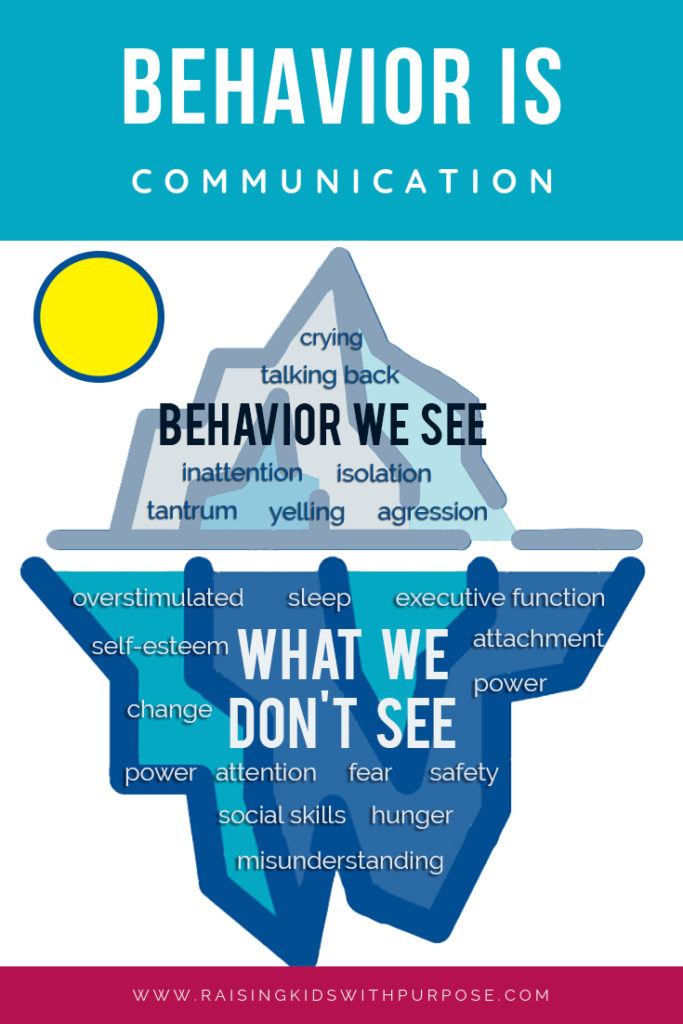
Above the surface, what you see:
The behavior
- The meltdown
- The refusal
- The attitude
- The shutdown
Below the surface — what’s actually driving it
What lives underneath
- Developmental stage | their frontal lobe is literally under construction and won’t be finished until their mid-twenties
- Unmet needs for connection, autonomy, rest, food, or safety
- Skills they haven’t built yet, there’s a difference between won’t and can’t yet
- Sensory overwhelm, exhaustion, or transition stress
- Something hard that happened at school, with a friend, in their own inner world
The behavior is never the whole story. It’s the part that’s visible. But if we only respond to what’s above the surface, we miss everything that actually matters.
Two Lenses That Change Everything
Same child.
Same moment.
Completely different outcome.
Not because of a technique. Because of a lens.
Lens 1: The Problem Lens
You see a child who won’t listen, who’s making your life harder, who should know better by now.
You ask: “How do I get them to stop?” “What consequence fits?” “Why do they keep doing this?”
The relationship becomes: you vs. them.
What your child learns: My big feelings are a problem. I am a problem.
Lens 2: The Curiosity Lens
You see a child who’s struggling, communicating something they don’t have words for yet.
You ask: “What’s going on for them right now?” “What do they need that they’re not getting?”
The relationship becomes: you and them, figuring it out together.
What your child learns: Even when I’m hard to be around, I’m still worth understanding.
The Long Game
The child who grows up being seen through the curiosity lens? They come to you as a teenager when things go wrong, because they’ve learned you’re safe. They develop a healthy relationship with their own emotions because you modeled curiosity instead of judgment.
They trust themselves because you trusted them first.
One Question To Shift Your Mindset About Your Kids
This tool isn’t about your nervous system. It’s about how you see your child and your perception.
Before you respond, ask yourself one question:
“What is going on for my child right now?”
Not: “What is wrong with them?” Not: “How do I fix this?” Just: What is going on for them?
Here’s how that question sounds in real moments:
Toddler melting down over the wrong cup:
“What’s going on for them? Tired? Hungry? Overwhelmed by a day they couldn’t control?”
Eight-year-old refusing homework:
“What’s going on for them? Fried after school? Anxious about getting it wrong? Needs connection before they can focus?”
Teen with a slammed door:
“What’s going on for them? Embarrassed? Scared? Carrying something I don’t know about yet?”
You don’t have to have the answer immediately. The question itself changes your posture. And your posture changes everything your child feels when they’re with you.
What Shifts When You Practice This
When you practice this question daily, something starts to shift. It may not change your child’s behavior at first, but it will change your relationship.
They start to feel seen. Really seen. Not managed. And a child who feels seen, opens up differently. Trusts differently.
This is how human beings work.
Something to Sit With This Week
The next time your child is at their most challenging, catch yourself.
Which lens are you looking through right now, problem or curiosity? You don’t have to have it figured out. You just have to notice. That awareness is the beginning of something.
Write it down if it helps: What is going on for them? Let the question do the work.
Want to Dig Into What You Actually Believe?
If you’ve been reading this and realizing you’ve been looking at your child through the problem lens and you don’t even know where that started, that awareness is not small.
That’s the beginning to breaking generational patterns!
Inside the PURPOSE Parent Transformation program, this is some of the deepest work we do together: examining what you actually believe, where it came from, and what it looks like to shift it. If you’re ready for that conversation, I’d love to sit with you in it.
Book a Parent Support Discovery Call


Hello!!! I’m Adriane. I’m a mom to three loud boys, am a research-a-holic and very passionate person who writes at Raising Kids With Purpose. Parenting can feel so hard sometimes but with mindset shifts and understanding, it can be very enjoyable. My hope is to inspire parents like you to create lifelong connections with your children and enjoy the journey along the way!