
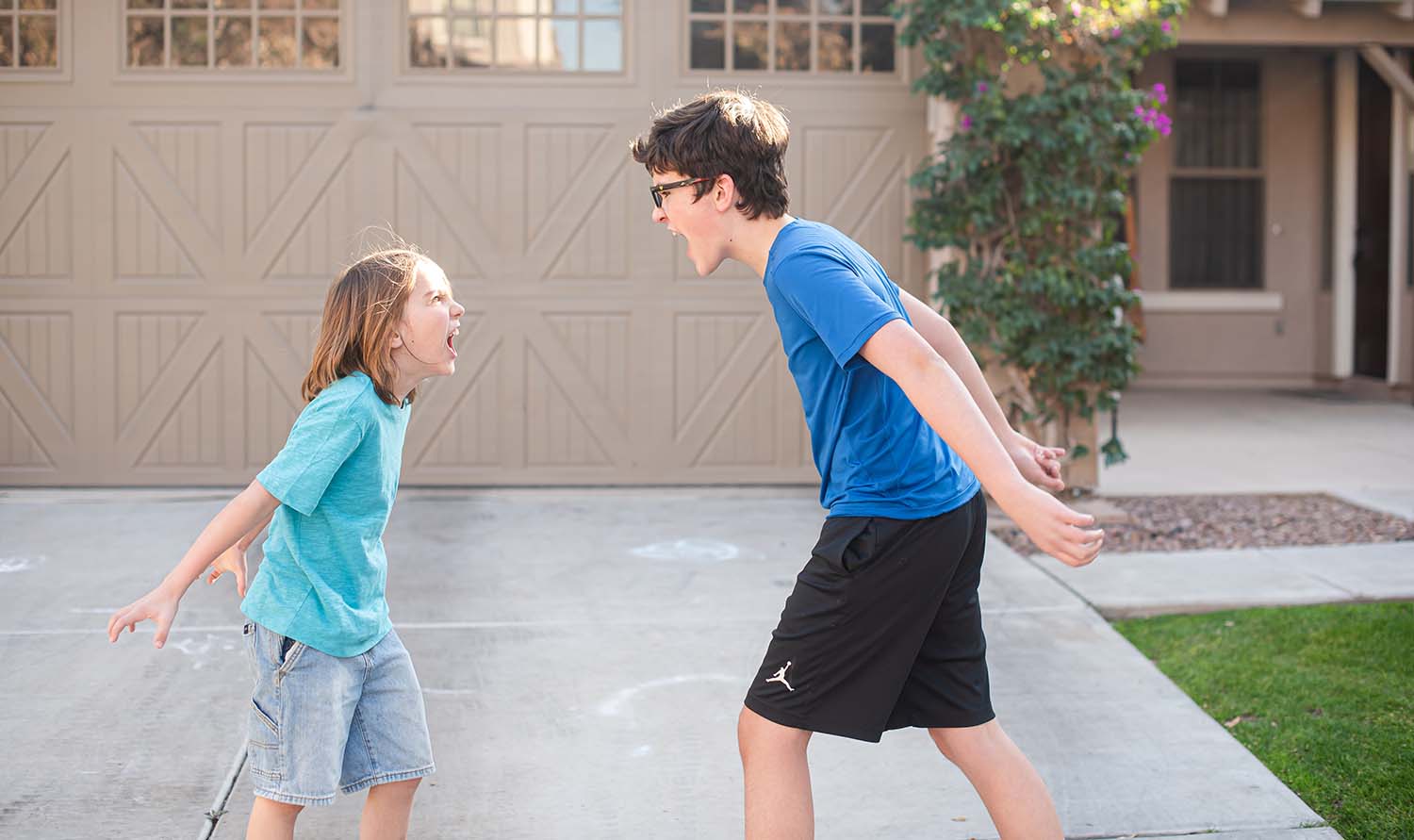
How to Stop Siblings Fighting Without Getting Involved

Inside: Siblings fighting can cause a lot of stress and anxiety for everyone in the family. This is definitely true for this scary time, as we are not getting any breaks from each other. The best way to manage sibling conflict is by providing them with the tools to develop skills they may not yet have.
Originally published: April 18, 2020
Updated: January 30, 2026
Last spring, I was sitting in the shallow water of my gym’s beach entry pool when I overheard siblings fighting. I didn’t really pay much attention until I heard the mom’s response to them screaming her name, wanting her to intervene.
Instead of telling them how to solve the problem, she simply asked, “Well, did you, “Walk, talk or rock?”
Did they what?!
You know, my ears perked up.
The little girl told her her mom, no, then went off with her brother and they talked a little and came up with a solution on their own. The fight ended in about two minutes flat before they were off playing with each other again.
Table of Contents
The Reasons Siblings Fight
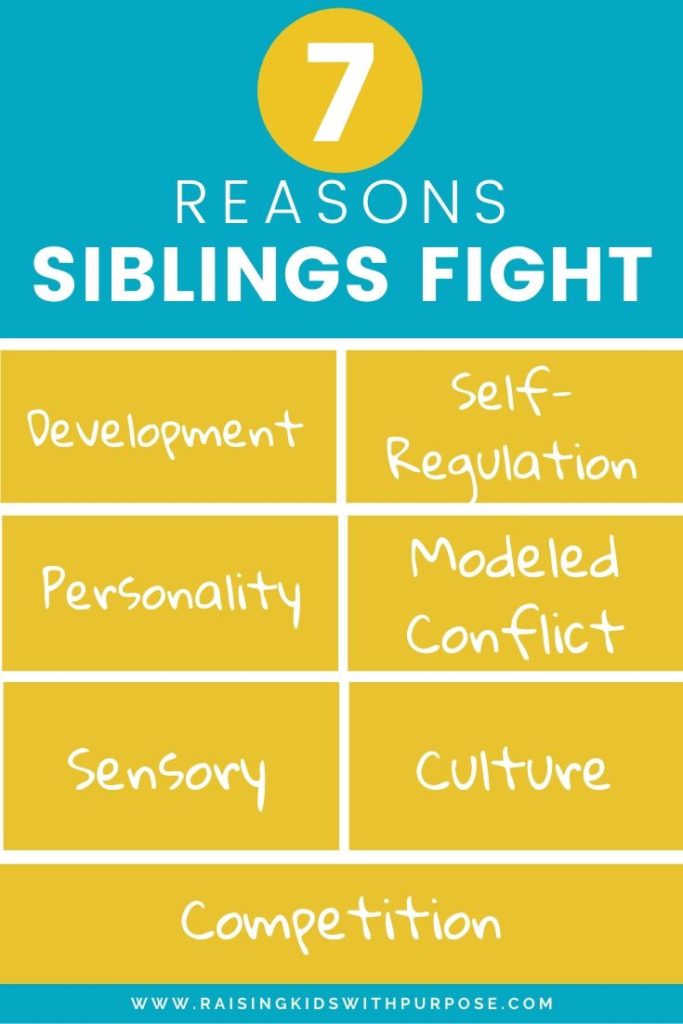
I break down the reasons siblings fight in this post. Basically, a lot is at play when it comes to brothers and sisters not being able to get along. Here are some of the main reasons:
- Development and maturity
- Sensory challenges
- Self-regulation skills
- Personality conflicts
- What is being modeled by peers, adults in their lives or other influences such as TV
- Culture
- Competition
It is good to look at the why behind any behavior so you know what to target in order for a change to happen. For my older boys, self-regulation and major sensory challenges and maturity all play a role in their sibling conflicts. One is incredibly impulsive and the other is highly sensitive so fighting can’t always be avoided.
The Key to Stop Siblings Fighting
My natural instinct when approaching sibling fights used to be to correct, increase the volume of my voice (so they could actually hear me), use a strict tone, and try to get them to stop immediately.
Or simply yell, “STOP FIGHTING!” or “BE NICE!”
However, this isn’t very effective. Womp Womp.
The reason is that if we take into account all the reasons why they might be fighting, being nice may not do the trick, or they may not be able to stop due to how their brains are wired.
Instead, the key to reducing sibling fighting is to guide your kids through conflict, not solve it for them.
What I’ve learned over the years is that our role isn’t to eliminate every disagreement. It’s to teach our kids how to navigate conflict in healthy ways.
This means:
- Helping them calm down first (they can’t think when their nervous system is flooded)
- Guiding them to express their feelings and needs
- Mediating (not dictating) solutions, they come up with together
- Teaching repair after they’ve hurt each other
I love this quote from Corinna Tucker, a professor at the University of New Hampshire: “The sibling relationship is where you learn how to fight.”
Oooh, that’s good!
As kids grow into teens and then into adults, they will face conflict with friends, family, teachers, coaches, co-workers, or bosses. Where they get the best practice to resolve conflicts is with their own brothers and sisters under your roof!
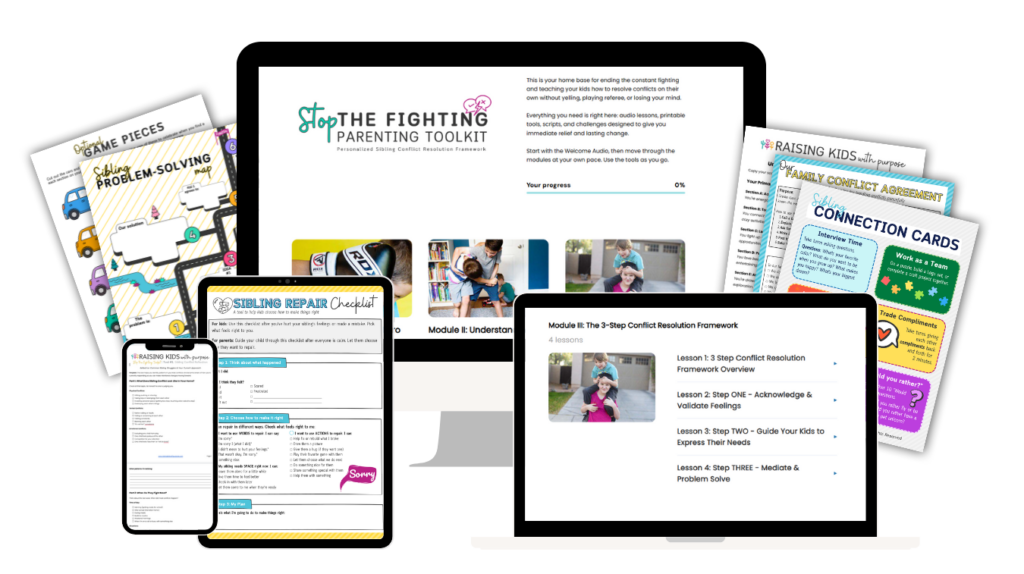
Want to learn my complete framework for guiding sibling conflict? I’ve created the Stop the Fighting! Parenting Toolkit with everything you need: audio lessons, scripts, and printable tools to help your kids fight less and resolve conflicts on their own.
Become Your Children’s COACH (Not Their Referee)
Kids need to be taught how to resolve their own fighting. The best way to do this is to mediate the situation.
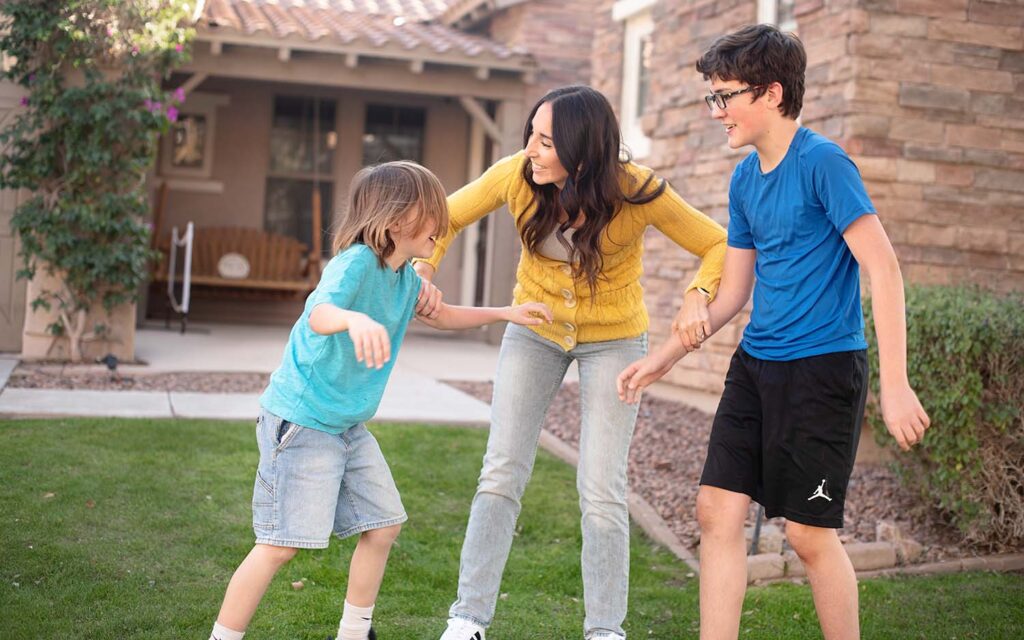
This does not mean you tell your kids what to say, such as, “Tell him, sorry,” or “Give back her toy,” but instead, guide the siblings into coming up with their own solution to the problem.
Your role is to:
- Create space for both kids to feel heard
- Ask questions that help them think (not tell them what to think)
- Guide them to express their feelings without attacking
- Help them brainstorm solutions together
- Check in with both kids to make sure the solution feels fair
Remember, this is their problem, not yours!
The goal isn’t to be the judge who declares a winner. The goal is to be the guide who teaches them how to work through disagreement.
This takes practice.
Both for you and for them. But the more you guide instead of tell them what to do, the better they’ll get at resolving conflicts on their own.
I go into more detail and give you a step-by-step process for mediating sibling conflict in the Stop the Fighting! Parenting Toolkit.
Fighting Rules
You want to make sure you set ground rules ahead of time. Include your kids in deciding what these rules should be at your next family meeting.
There is a good chance they won’t follow all of these rules all of the time, but they’re good to have so your kids know what to strive for and what is important to your family.
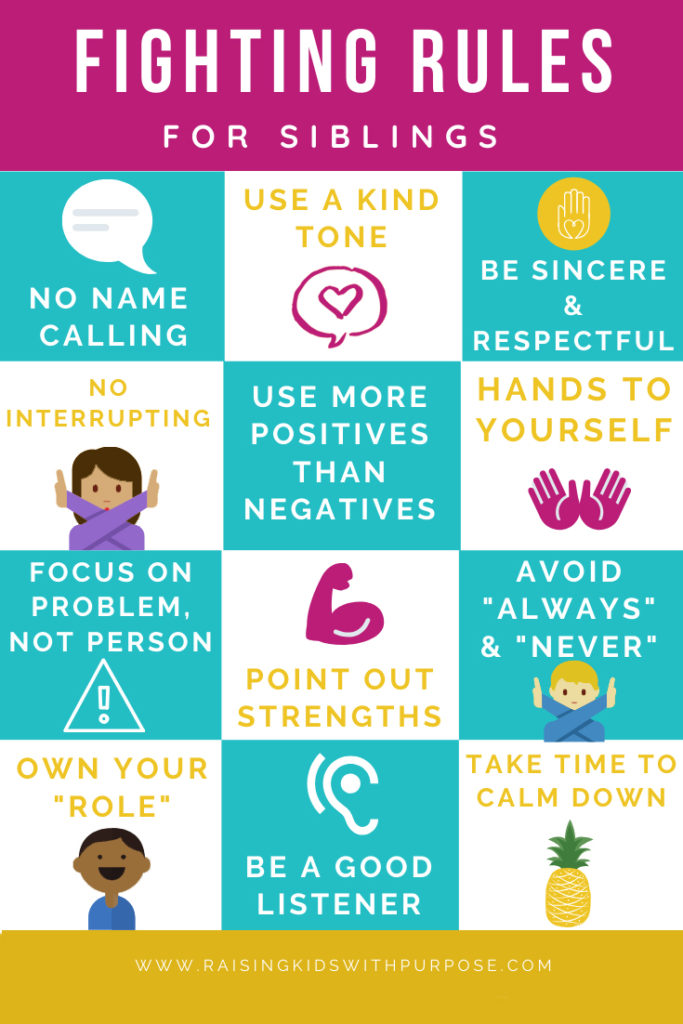
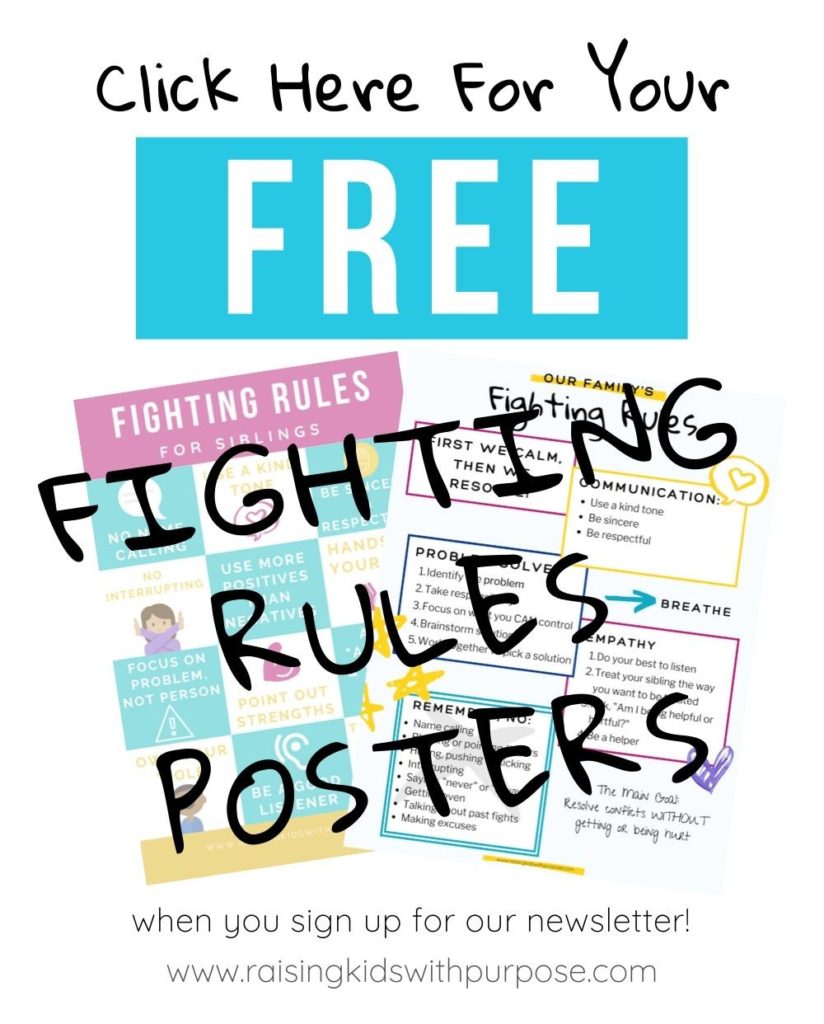
Pssst: You can snag this as a poster along with the “Our Family’s Fighting Rules” Poster when you sign up for my newsletter.
Calm Down Time
If the situation is already heated, there is zero reason to focus on getting your kids to work out a problem.
They can’t.
In order to think rationally, kids need to first be connected to the thinker part of the brain, the prefrontal cortex. This shuts down and is inaccessible when the brain perceives a threat. It goes into fight or flight and angry, frustrated, or super sad states.
In our house, the first step is to separate.
For some reason, though, this is very difficult for our boys to do. Although they’ll be mad at each other, they can not physically get away. As a parent, it’s so frustrating. What we have been focusing on is getting them to be self-motivated to leave each other alone to cool off.
When I say the goal is to get your kids to resolve conflicts with you, it’s still important to know you need to be involved, especially if they are going to hurt each other with words or physical actions.
Eventually (and this can take years), the goal is to get them to a place where it doesn’t escalate to the point that they need to be separated.
Read next: How to Define and Discover Your Family Values
Talk It Out
If your kids are younger, they may need your help in mediating who talks first. Allow each child to tell his or her side of the story and make sure the sibling actually listens.
As your kids get older, they need to learn how to do this on their own while following the fighting rules. It’s very hard to listen when someone is shouting or touching you.
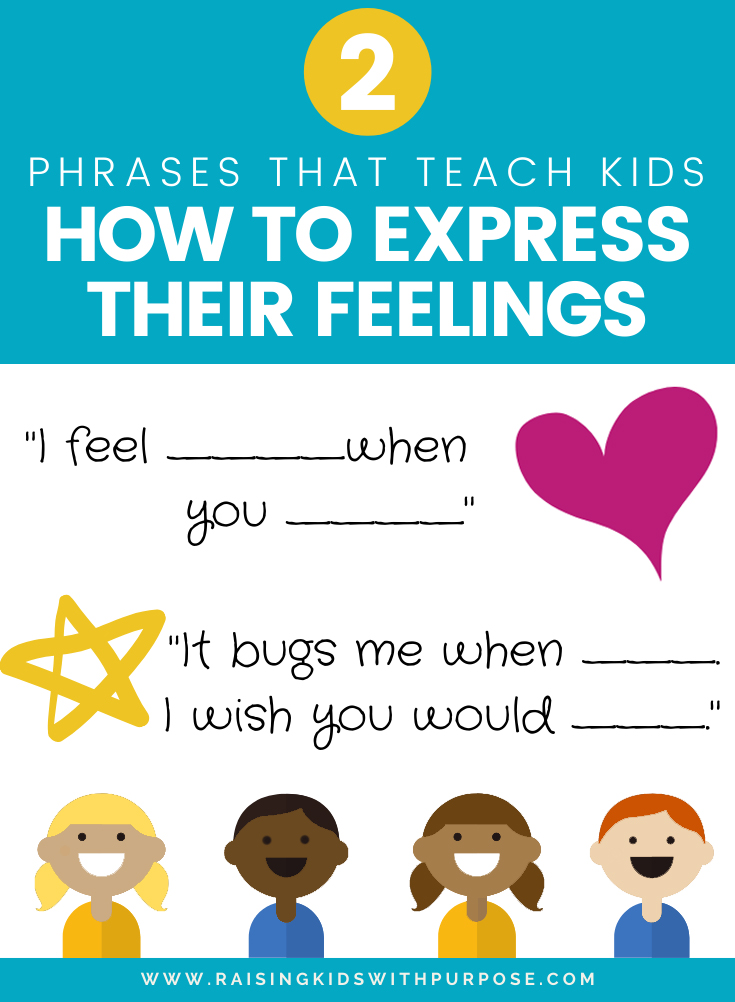
Talking it out is much easier for siblings to do if they are given tools on how to communicate.
We have adopted “A Bug and a Wish” and “I feel when statements.” This makes it easy for each of our boys to express his or her feelings using words, not hands. In turn, it helps the child receiving the message understand how his or her actions are affecting others.
Perspective Taking
This is a big part in resolving conflicts. Kids are self-centered thanks to the under-development of the dorsolateral prefrontal cortex. They don’t have the developmental skills to understand or interpret how their actions affect another; especially a sibling. Therefore, they need to be taught.
A great way to do this is to ask questions! “How did your actions make your little sister feel?” or “Do you notice how he is feeling right now after you pinched his arm?”
Allow your child to do the thinking with your guidance!
>>Bonus Tip!
I read a research study about how siblings fighting can lead to poor mental health to my 10-year-old, and immediately, I could see that he had an “uh oh” feeling in his gut. I wasn’t using this information to make him feel shame, but rather, a little guilt. It helped him understand that his actions can make a lasting impact on others – for better or for worse.
Since sharing that information, his perspective has shifted a little causing him to put a lot more effort into resolving conflicts with his brother in a non-physical way. It has really brought them closer together…for the time being.
Mediation: Your Role in the Middle
Here’s what I’ve learned after years of navigating sibling conflict: Your job isn’t to solve the problem. Your job is to guide them to solve it themselves.
This is called mediation, and it’s one of the most powerful tools you have as a parent.
Here’s what mediation looks like:
- Stay neutral. Don’t take sides. Both kids need to feel seen and heard.
- Ask questions. “What happened?” “How did that make you feel?” “What do you need right now?”
- Reflect back on what you hear. “So you’re upset because he took your toy without asking?” This helps them feel understood.
- Guide them to express their needs. “Can you tell your brother what you need using your words?”
- Let them come up with the solution. “What can we do so you both feel good about this?”
When you mediate instead of dictate, you’re teaching them:
- How to communicate their needs
- How to listen to someone else’s perspective
- How to problem-solve collaboratively
- How to take responsibility for their actions
This is skill-building, not behavior management.
And the more you practice this, the less they’ll need you to step in. Eventually, they’ll start working things out on their own.
Want the complete framework for mediating sibling conflict? The Stop the Fighting! Parenting Toolkit walks you through exactly how to do this. It has scripts, audio lessons, and printable tools.
Solution Time
Typically, by the time our kids talk it out, they’re already onto the next thing. However, some conflicts need solutions. The reason is for both parties to move on so that conflict doesn’t happen again in the near future.
This can be done in any fashion that works best for your family. Every child is unique and handles stress differently. Siblings can write ideas that would work for both kids, draw pictures, or simply both come up with an idea and decide on which one would work best.
Act of Kindness
One last thing we do if the “offense” is bad is to encourage the offender to do an act of kindness for the brother or sister. Another phrase we often use is, “What can you do to make things right?” We also ask, “How do you think he or she is feeling?” Instead of forcing a child to say, “Sorry.”
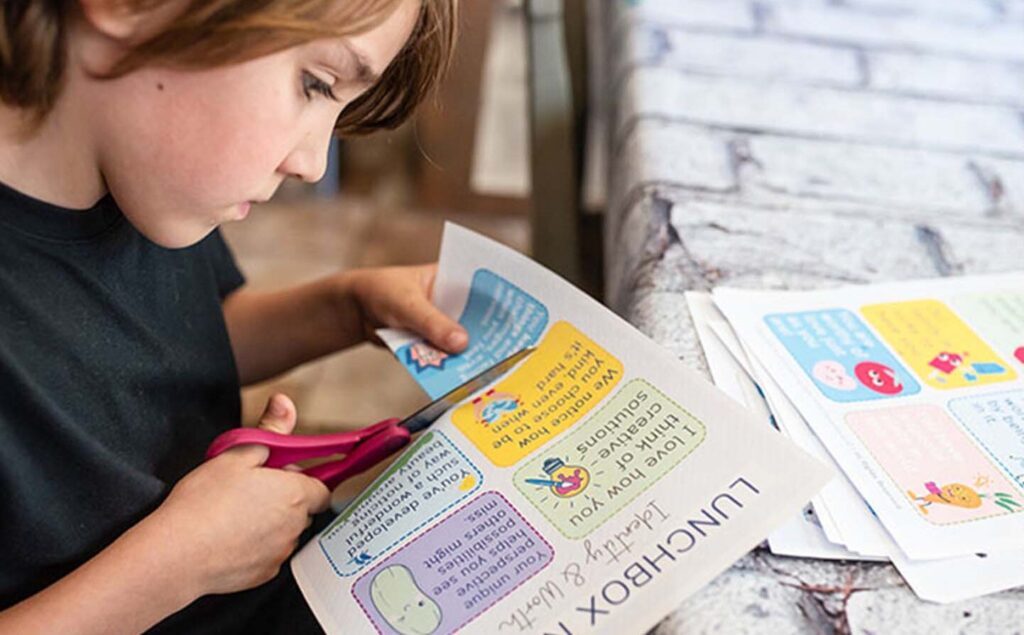
A great way to do this is to have your kids fill out kindness cards or do chores for each other. They can also play games together. In the Stop the Fighting Parenting Toolkit, there are Sibling Connection Challenge Cards that give your kids ideas on how to connect and have fun together.
Walk, Talk, or Rock
Now back to walk, talk, or rock. After understanding what needs to happen to help kids solve their own conflicts and fight less, this strategy is brilliant!
This simple parenting tool incorporates basic conflict management skills for kids in a playful way that gives your kids control.
When introducing the concept, go through what each of the words means:
Walk – Either party can choose to walk AWAY. As I mentioned, our boys have a very tough time with this one. But for some reason, if it’s an option in this context, they are more likely to do it.
Talk – Together, your kids can choose to use their words (not hands) to solve the problem. Give them different ways to talk as mentioned above.
Rock – If the argument is over a toy that one person wants or an activity he or she wants to do, the siblings can do “rock, paper, scissors” to see who gets it. This could cause more issues, but usually, it’s a quick solution.
Your Role in Ending Sibling Fighting
All of the above steps help kids resolve their own conflicts. When teaching these skills to your kids, it’s important that you:
- Let your kids work out the problems on their own (after you’ve taught them how)
- Only intervene if it’s getting physical or harmful (safety first, always)
- Do not take sides. Both kids need to feel seen and heard
- Model good conflict management yourself. They’re watching how you handle disagreement
- Have patience. This is a skill that takes time to develop
- Guide, don’t dictate. Ask questions instead of giving answers
Remember: You’re not trying to eliminate conflict. You’re teaching them how to navigate it in healthy ways.
The goal is for your kids to eventually resolve disagreements without you. But they need you to guide them through the process first.
If you want a step-by-step framework for guiding sibling conflict (plus scripts for what to say in the moment), check out the Stop the Fighting! Parenting Toolkit.
Ending Sibling Fights
Next time your kids are ready to battle it out, instead of running to the rescue and solving their problem or telling them what to do, let them work it out. And if they don’t have the tools yet, start loading up that toolbox!
Bonus! Fighting Rules!
For you! When you sign up for my newsletter, you will get a PDF you can download with two different fighting rules posters to hang and use as a reminder for your kids.
How do you handle sibling conflict?
Comment below and let me know what kind of tricks, tips, or strategies you employ when there is constant fighting in your house!

Hello!!! I’m Adriane. I’m a mom to three loud boys, am a research-a-holic and very passionate person who writes at Raising Kids With Purpose. Parenting can feel so hard sometimes but with mindset shifts and understanding, it can be very enjoyable. My hope is to inspire parents like you to create lifelong connections with your children and enjoy the journey along the way!




My 11 year old son and 7 year old daughter fight all the time. I come from an abusive family so I do not have good examples on how to react during this situations. All I know is that I hate it. I don’t want to scream at them or call them horrible names like my mom used to do to me. This article is giving me lots to work with. Thanks!
Awe that hurts my heart you grew up in that kind of environment. Screaming does nothing and is extremely unhelpful. If I ever feel myself getting to that point, I whisper those exact words to myself “Yelling is unhelpful.” You have the power to break the generational cycle of that abuse and even yelling/screaming. Thank you for sharing and I’m happy this can help!
These are great tips. I will save for when I have older children 🙂 Thanks for sharing!
Of course!
You’re welcome!
This is so timely and your fighting rules are so helpful. With a house of 4 little kids, we have lots of arguing! I’ll be printing your rules to hang in our school room. Thank you for the helpful tips!
Oh I’m sure! At least they have each other during this time. I hope the rules help!
I”m sure! At least they have each other during this time though. Thank you!!
These are great tips. I will definitely need to imply these more on my kids. I believe that they grow as they learn to manage their conflicts.
Yes, they sure do grow and learn!
These parenting tips are really wise and helpful! I’ve got three kids and sibling fights are really common in our home! Thanks for yo ur advice!
Thank you so much! They’re learning so many new skills when the fight!
This is such a great post!! I have never heard of the “Walk, Talk, or Rock” concept, but it’s brilliant! The kindsness cards are a great idea as well! When my daughters argue, I have them say 5 things that they like about the other one.
Thanks again, your posts are always so helpful!
Awe, thank you so much, Starr! I hadn’t either and also thought it was brilliant! It keeps the ball in their court and helps kids learn valuable life skills! I love how you have your girls give positive affirmations to each other! We try that sometimes but it doesn’t always go so well. Not sure if it’s because they’re boys or just because they rather call each other names. LOL! Thank you!
I currently only have one child, but the resources in this post will be so helpful to parents with multiple children in the house. I can even adapt them for use in my classroom, when schools are back in session.
Absolutely! Conflict management in the classroom is huge!
I had no idea about “Walk, Talk or Rock” but as you explained it towards the end, it made sense, lot of sense. Wish there were such things when we were growing up. These are some amazing tips for parents with two ore more kids, These also help kids with conflict solving in the long run. Thanks for sharing!
I know, right? We just know so much more about brain development and psychological health! I’m super thankful for all the researchers and experts out there!!! And you are very welcome 🙂
These are great tips! I try to help my kids understand why fighting isn’t good and to compromise.
compromise is a good idea!
I love “Walk, Talk or Rock”! How awesome of an idea! I’ve only got one kiddo but I will forward this to friends with multiple children!
Yes! It works GREAT!!! It gets my kids to work out their own problems as long as they do it before it gets physical. #boys!
I have already implemented A Bug & A Wish from your previous post, so Walk, Talk, Rock is a natural logical next right thing! Thanks for sharing. I told my DV therapist about A Bug & a Wish last month and she liked it so much that she asked if she could share it with her other DV clients. We do the birthday candle blowouts (inhale and exhale in several sort bursts), when the screams and tattling start. Now I know to use the W, T, R after they are calm enough to be coherent. Great stuff, Adriane, You’re a Godsend.
Awe this is the sweetest comment ever! I’m so happy it’s helping. And thanks for sharing!! Yes, when I heard the rock, talk and walk, I knew I had to share it with others. It’s such a great tool. Thank you for all your love and support <3
I’m going to add your printable to our family binder!
It’s hard with an almost 12 year old and a newly 5 year old … and being on week 6 of lock down.
I think it’s their maturity levels mostly.
We try to encourage our kids to figure things out amongst themselves as well.
It helps if we can catch them and coach them before it escalates.
They’re both so passionate and will hold their ground.